Learn pi by heart
and train your memory
With memoπ you will soon know 500 decimal places of pi by heart. To get there you first learn the Major system: turn numbers into pictures and find out how reciting pi becomes telling a good story.
| Feature | In the browser | In the iPhone app |
|---|---|---|
| Learn the Major system | free | free |
| Learn 20 digits of pi | free | free |
| Learn 500 digits of pi | not in the browser | €4.99, once |
Everything here is in English — the trainer, the method with its sources, the basic code, and all hundred image words.
Learning digits with the Major system
People who can remember thousands of digits are not superbrains. They apply a suitable method, a so-called mnemonic. The method you use in memoπ to learn the decimal places of pi by heart is called the Major system. It works by translating digits into words and building a story out of those words. Every documented pi record rests on a system of this kind.1
Visible progress
One mark per sentence
The 500 digits stand as 125 marks in a circle — one per sentence. One glance tells you where you stand.
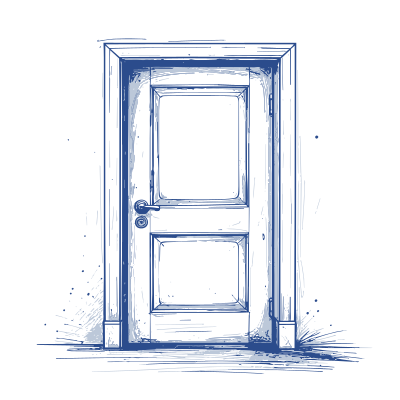 door
door
100 image words
This is how 14 becomes the door
For every pair of digits you learn an image word. The 1 stands for d, the 4 for r. So 14 becomes the door, and the door becomes part of your story.
3,1415 …
Recall
Typing, not looking up
The template disappears as soon as you have typed it once. After that memoπ asks — and only the effort of remembering lays the trace that still holds tomorrow.
Review
The gaps grow with you
Once a sentence sits, it comes back after ten minutes, then after an hour, then in days and finally after five weeks. A mistake sends it back to the first step.
More built-in learning methods
- Four digits at a time
- Working memory reliably holds about four items. That is why you learn π in sentences of four digits: 500 digits turn into 125 building blocks, and each one is a unit you recall as a whole.
- Typing, not looking
- Recalling from memory strengthens far more than reading again — the testing effect is one of the most robust findings in learning research. So every digit here is typed, never merely looked at; even memorising means typing.
- Twice right, then relearn
- Twice right and a sentence counts as learned — after that it returns at growing intervals. Exactly this pattern, recalling to a criterion and relearning later, has been studied as successive relearning: the most durability for the least effort.
- Growing intervals
- Reviews work best when they come shortly before forgetting. The ladder: 10 min → 1 hr → 8 hr → 1 day → 3 → 7 → 16 → 35 days. A mistake sends the sentence back to the first step.
- Training the transitions
- Serial sequences break at the boundaries: inside a sentence the unit carries you, between two sentences you need a path. So every new sentence is attached to the previous one right away, and every review asks with the predecessor as anchor — you practise the way you will recall.
- Mistakes are a signal
- A mistake does no harm as long as the correction follows immediately — it can even improve retention. So memoπ shows the correct sequence in red at once, you memorise it again and recall it right away.
- The test run from digit 1
- Everything in one go, one mistake ends the run: that is exactly the target task and another act of recall at the same time. Where the run breaks, that sentence becomes due again immediately — you practise where it falters.
- Images instead of bare digits
- Every pair of digits has a fixed image word from the Major system (14 → door): digits stand for consonant sounds, sounds become words. From the two image words you build your own sentence — the words are given, the sentence is yours, and what you generate yourself sticks better. Every documented π record rests on this kind of encoding.
Start in your browser, continue in the app
On this website you can discover the Major system and learn the first 20 decimal places of pi. After that you continue in the memoπ app for iPhone. If you want to learn up to 500 digits, you pay €4.99 once.